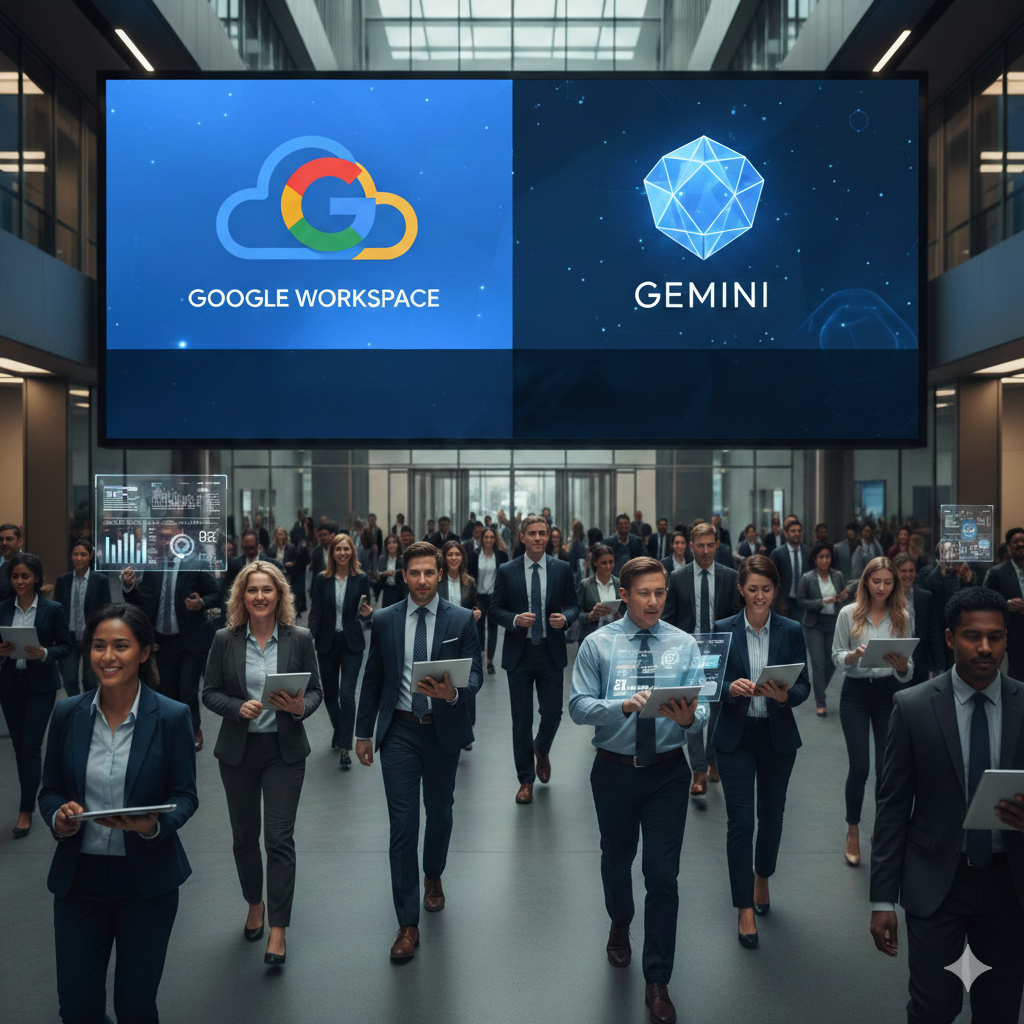
50,000 Federal Employees Are Moving to Google Workspace. Now What?
The U.S. Department of Transportation is the first cabinet-level agency moving its workforce to Google Workspace with Gemini.1 Over 50,000 DOT...
4 min read
RightSeat AI TrustLab Team
:
Feb 16, 2026 10:25:36 AM
The U.S. Department of Transportation is the first cabinet-level agency moving its workforce to Google Workspace with Gemini.1 Over 50,000 DOT employees are shifting off legacy tools and onto Gmail, Docs, Drive, Meet, and an integrated AI assistant most have never used in a work setting.
The contract is a five-year, $89 million deal through GSA’s OneGov strategy.2 About 12,000 users are already onboarded, with the rest coming this year.1 The foundational deployment was completed in just 22 days.3 The speed is impressive. But speed of deployment is not the same as speed of value.
This is not a routine software upgrade. It is a simultaneous platform migration and AI adoption for a workforce that is also being asked to do more with fewer resources.4 The gap between having new tools and getting value from them will be determined by one thing: workforce readiness. That means people know what to use Gemini for, how to verify its outputs, and when to rely on their own judgment instead.
The potential upside is real. Google reports that enterprise customers using Gemini in Workspace save an average of 105 minutes per user per week, and 75% of daily Gemini users say it improves the quality of their work.5 Google estimates that government-wide Workspace adoption could save federal agencies up to $2 billion over three years.6 These are vendor-reported figures, and results will vary by agency, role, and data maturity. But even at a fraction of those numbers, the potential return is substantial.
But those numbers come from organizations where employees were equipped to use the tools effectively. At DOT, employees are being asked to learn a new platform and develop AI fluency at the same time, under pressure, with fewer experienced colleagues to lean on. Without deliberate investment in workforce capability, the savings projections stay theoretical.
We’ve written before about the critical distinction between adoption and adaptation.7 Adoption means giving people access and showing them features. Adaptation means building organizational capability to work differently because AI is now a collaborative partner.
Here’s what the gap looks like in practice for DOT employees:
|
Task |
Adoption |
Adaptation |
|
Briefings |
“Use Gemini to summarize documents for executive briefings.” |
“Redesign how briefings are produced so Gemini synthesizes research while analysts focus on strategic recommendations.” |
|
Procurement |
“Use Gemini to draft contract language faster.” |
“Rethink procurement workflows so AI handles initial drafts while specialists focus on compliance review and risk assessment.” |
|
Safety Data |
“Use Gemini to pull incident statistics into a spreadsheet.” |
“Redesign how safety teams analyze trends so Gemini surfaces patterns across datasets while inspectors focus on root-cause investigation.” |
|
Directives and Notices |
“Use Gemini to draft routine orders and notices faster.” |
“Build standardized templates and verification workflows so AI-generated drafts meet plain language requirements and agency formatting standards while specialists focus on accuracy and compliance review.” |
The difference is not the tool. It is whether your workforce has been equipped to rethink how they work.
Organizations excelling at AI-integrated platform transitions consistently focus on three areas.
1. Hands-on practice with actual work. The most effective learning happens when employees apply new tools to tasks they already perform daily. For DOT staff, that means practicing with Gemini on real briefings, real procurement documents, and real policy research. Generic training builds awareness. Real application builds capability.
2. Peer learning and knowledge sharing. The best practices will emerge from frontline employees discovering what works in their specific context. An FAA analyst will find different use cases than an NHTSA researcher. When organizations create simple channels to share wins, effective prompts, and workflow examples, capability spreads faster than any formal training program can deliver.
3. Leadership-driven AI fluency. AI fluency means understanding when to trust AI output, when to challenge it, and how to integrate it into decision-making. In a regulatory environment where accuracy has real consequences, this is especially critical. That fluency has to start at the top. When leaders model it, permission to learn follows.
At RightSeat, we serve as the human co-pilots for your AI journey. While your IT team handles technical configuration, we help your workforce develop the capability to capture the full value of the investment.
AI Fluency. We build your teams’ ability to work effectively alongside AI, starting with real workflows, not feature demos. Through hands-on practice with actual tasks your employees perform daily, we develop the judgment, confidence, and muscle memory that generic training cannot deliver.
Innovation Workshops. We work with your teams to pinpoint high-value use cases where Gemini and Workspace can drive immediate productivity gains. These collaborative sessions ground your deployment in real work and surface the creative applications that only your people can identify.
Trust and Responsible Use. We help establish clear standards for verification, governance, and responsible use, then identify and empower internal champions who can scale what works across the organization. For government teams, this includes ensuring alignment with compliance obligations and data sensitivity requirements from day one.
Every month that tens of thousands of DOT employees go without effective enablement is a month of unrealized productivity, missed savings, and growing skepticism. Organizations that treat workforce readiness as an afterthought end up with expensive tools that people avoid or misuse.
The agencies pulling ahead will not be the ones that deployed fastest. They will be the ones whose people know how to use these tools well, responsibly, and in ways that genuinely improve how work gets done. That capability gap is closable, scalable, and for the organizations willing to invest in their people, a genuine competitive advantage.
When you’re ready to move from having AI to working with AI, RightSeat is here to co-pilot the journey with you. If your team is rolling out Workspace and Gemini, let’s talk about what a workforce readiness plan looks like for your agency.
Add your email below and we'll send you newsletters and blog updates from the RightSeat AI TrustLab
The U.S. Department of Transportation is the first cabinet-level agency moving its workforce to Google Workspace with Gemini.1 Over 50,000 DOT...
The Year AI Gets Real: Accountability Replaces Ambition and Adaptation Beats Automation Something shifted in the past six months. Executives...
How transparency raises standards, reduces disputes, and prepares students for professional work.